
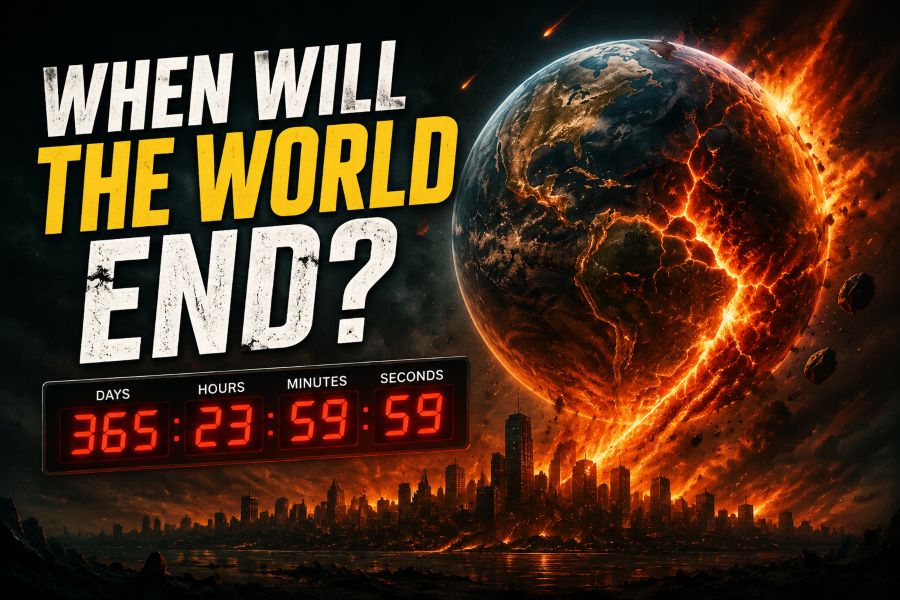
A when will the world end timer is usually a dramatic countdown, prediction page, or symbolic clock that claims to measure how close humanity is to catastrophe. It attracts attention because it turns a frightening question into something visual, simple, and instantly understandable.
The idea is powerful, but it should not be treated as a literal forecast. No verified scientific tool can name the exact day, hour, or minute the world will end.
Most end-of-the-world timers are built around speculation, entertainment, religious interpretation, climate anxiety, asteroid fears, artificial intelligence concerns, or symbolic risk models. They can be interesting, but they need context.
This article explains what these timers mean, why people search for them, what they can and cannot prove, and how to understand the subject without falling into panic or misinformation.
The phrase sounds precise, but it usually points to uncertainty. People want a clear answer to a question that does not have one.
Some timers are fictional or satirical. Others use real global risks as inspiration, but simplify them into a countdown format.
A countdown can make danger feel measurable. That is useful for storytelling, but it can also create false confidence.
Humanity faces real risks, including climate change, nuclear conflict, pandemics, ecological damage, and emerging technologies. None of these comes with a universal expiration date.
The best way to read a world end timer is as a prompt for reflection, not as a confirmed schedule.
What Is a World End Timer?
A Symbolic Countdown
A world end timer is often a symbolic countdown designed to represent danger, uncertainty, or urgency. It may look like a clock, calendar, or digital timer, but its meaning depends on who created it and what assumptions they used.
Not a Scientific Deadline
No global scientific authority has established an exact end date for Earth or human civilization. Science can estimate risks, model scenarios, and track warning signs, but it cannot produce a guaranteed final countdown.
A Search Driven by Anxiety
Many people search this keyword during periods of war, extreme weather, economic instability, or viral predictions. The timer becomes a way to process fear, even when the information behind it is weak.
Different Timers Use Different Logic
One timer may focus on climate thresholds, another on religious prophecy, and another on fictional apocalypse themes. Because the inputs differ, the results can vary wildly and should never be compared as equal evidence.
The Role of the Doomsday Clock
The Doomsday Clock is one of the best-known symbolic risk indicators, but it is not a literal timer. It reflects expert concern about human-made threats and is meant to encourage public attention and policy action.
Why the Format Feels Convincing
A ticking clock feels authoritative because it is visual and specific. Even when the number is invented, the format can make the claim seem more certain than it really is.
How to Read It Carefully
The safest approach is to ask who made the timer, what data it uses, whether its assumptions are explained, and whether credible experts support the conclusion. If those answers are missing, treat the timer as entertainment or opinion.
Why People Search for This Timer
1. People search for this timer because uncertainty feels easier to face when it appears as a number.
2. Some users are looking for entertainment, viral content, or a dramatic visual to share online.
3. Others are responding to real concerns about war, climate change, technology, or social instability.
4. Many searches come from curiosity after seeing a prediction, video, headline, or social media post.
5. The search often reflects a deeper need for reassurance, context, and trustworthy information.
Signs a Timer Is Not Reliable
- No sources: A timer that gives a precise date without explaining its evidence is not reliable.
- Extreme certainty: Claims that the world will definitely end at a specific moment should be treated with skepticism.
- Hidden method: If the creator does not show how the countdown was calculated, the number may be arbitrary.
- Fear-based language: Pages that rely on panic, shock, or threats are often designed for clicks rather than accuracy.
- Single-cause thinking: Real global risk is complex, so a timer based on one event or one prediction is usually oversimplified.
- No expert review: A serious risk model should be connected to transparent research, qualified analysis, or recognized institutions.
- Sales pressure: If the timer pushes survival products, secret reports, or paid predictions, question the motive behind it.
How to Think About End-Time Claims
Separate Risk from Prediction
A real risk is not the same as a fixed prediction. Climate change, nuclear weapons, and pandemics deserve serious attention, but acknowledging them does not mean accepting a countdown as fact.
Look for Transparent Evidence
Credible claims explain their sources, assumptions, limits, and uncertainty. If a timer offers only a dramatic number, it is missing the basic structure of trustworthy analysis.
Understand Probability
Many global threats are discussed in terms of probability, not destiny. A possible event can be important without being inevitable, and good planning often reduces the chance of worst-case outcomes.
Avoid Viral Panic
End-of-the-world claims spread quickly because they trigger strong emotions. Before sharing one, check whether reputable scientific, government, or academic sources are saying the same thing.
Focus on Practical Action
The most useful response is not panic, but preparation and responsibility. Supporting climate resilience, public health, conflict prevention, and trustworthy technology governance matters more than watching a timer.
Know the Entertainment Factor
Some countdowns are built for games, videos, fiction, or themed websites. They may be engaging, but their purpose is experience and suspense rather than factual forecasting.
Protect Your Mental Space
If these searches make you feel overwhelmed, step away from alarming content and look for grounded information. A timer should not control your mood, choices, or sense of the future.
A when will the world end timer can be fascinating, but it is not a verified answer to the future. Most versions are symbolic, speculative, fictional, or designed to capture attention.
The world faces serious challenges, and some deserve urgent action. Still, urgency is different from certainty, and no countdown can replace careful evidence.
The best response is balanced awareness. Learn about real risks, check reliable sources, and avoid treating viral timers as proof.
In the end, the value of the question is not in finding an exact final date, but in asking how people can make the future safer, more stable, and more responsible.
FAQs About when will the world end timer
Is there a real when will the world end timer?
There is no official timer that can accurately count down to the end of the world. Most timers are symbolic, fictional, speculative, or based on limited assumptions.
Can scientists predict the exact end of the world?
Scientists can study risks and long-term cosmic events, but they cannot predict an exact date for the end of Earth or civilization. Reliable science usually deals in evidence, models, and probabilities.
Is the Doomsday Clock the same as a world end timer?
No. The Doomsday Clock is a symbolic warning about human-made global risks. It is not a literal countdown and does not predict a specific end date.
Why do world end timers appear online?
They appear because dramatic countdowns attract attention. Some are made for entertainment, while others try to visualize fears about war, climate change, disasters, or future technology.
Should I believe a timer that gives an exact date?
You should be skeptical of any timer that claims an exact date without transparent evidence and credible expert support. Precise claims about the end of the world are almost always unreliable.
What should I do if end-of-world content worries me?
Limit exposure to alarming content, check reputable sources, and focus on practical actions within your control. If the anxiety feels intense or persistent, talking with a trusted person or professional can help.